Thursday, May 31, 2007

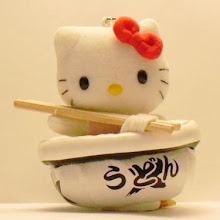
Udon: Soul Food?

I think one of the reasons why regional kitties continue to catch my fancy is because of their link to the tradition of souvenirs-as-gifts or omiyage. When a traveler returns home or to work, they will bring a small item from their trek, usuallly representing a regional specialty. These regional specialty items are referred to as meibutsu. This way, the traveler is able to share their experience with family, friends and coworkers and pay their respects for those who didn't get to tag a long or didn't get the time off... good Kitty, good manners.

Often times the meibutsu is a specialty food that often times has a story behind it -- like "soul food" in this country. Historically, soul food has a very specific definition, but for those who actually make it and eat it? Its about a connection to the regional agriculture, family/cultural roots and a strong sense of the food having some spiritual connection to the heart (has to be made with love/attention) and soul (intent/purpose).

I saw a food-themed movie from Japan called "Udon" - perhaps my favorite noodle variety. It is the story of a prodigal-like son who returns to his hometown of Sanuki after failing to make it as a comedian in New York City. His homecoming isn't quite what he hoped it to be. His surly father, a seemingly unimaginative udon maker is quick to remind his son of his insults to the family business before he ran off to the States.

"HOW TO MAKE UDON"

Sequence from the movie "Udon" featuring the making of this wonderful noodles


It's hardly an original story to be told, but I loved it. Any story told via the medium of food has my attention. Combine it with a favorite food, I'm ready to give it four stars. Anyways, as the story continues, the lost son takes an unintentional pilgrimage around the region to obstensively report on the various hidden Udon stands and slowly begins to find his way home and back to his family.

The movie boldly states that Udon is the true soul food of Japan -- not sushi! And just how does this movie go about convincing us? Well, let's have Kitty take over on that one...

The Spiritual Roots of Udon:
Kukai, 8th century Buddhist Kahuna and Noodle Dude

Kitty appears as two of Sanuki's most famous treasures - Kukai and a bowl of udon.


Born in the Sanuki region of Shikoku, Kukai came from a well-to-do family. Time had reduced the families influence in Court, so they groomed the young Kukai for a future in Court politics. Despite their best efforts, Kukai showed more of an interest in spiritual matters and eventually abandoned his studies and literally headed for the mountains for meditation and spiritual studies. Eventually, Kukai was able to wrangle a spot in on a government mission to China. It would be here where Kukai would begin his studies in esoteric Buddhism AND learn about the dumpling that would eventually become Sanuki's Udon.

The udon legends say that when Kukai returned from China and was sharing his spiritual revelations, he also shared the recipe for noodle dumplings with local farmers. Perhaps it was Kukai's influence or more likely the climate of the region (little rainfall that makes rice cultivation difficult) that made Sanuki spiritual home of udon. Many in Japan will travel to the region just to taste the "real thing."

There is another soul-food link to the noodle. People will travel to Sanuki and the island of Shikoku is to take the Shikoku Henro. This is a pilgrimage made to the 88 temples and sacred places that encircle the island of Shikoku. It is meant to recreate the steps that Kukai made in his search for truth. Traditionally, this pilgrimage is taken on foot, covering a distance of 1200 kilometers, taking about 30-40 days. This trip is by no means a pleasure hike through the beautiful scenery of the island. It is a long, arduous journey that is meant to break down the body and the barriers of the mind. It is in those moments of being stripped of illusions that many believe healing and enlightenment can be received.


Kitty prepares for the arduous pilgrimage in full ohenro garb. Her bag bears the words "two traveling together", reminding her that Kukai will be with her on this journey.


The pilgrim or ohenro-san is traditionally clad in a white (the "uniform" of the pilgrim), carrying a walking staff (a reminder that Kukai is with them, ready to offer guidance when the pilgrim falters). The traditional garb also let's everyone know that these travelers are here for the pilgrimage and should be treated with respect. Often times locals will offer gifts of aid or osettai - this can be money, food or a place to rest. Not surprisingly, some towns on the route will offer free udon to the weary traveller - yet another reminder that Kukai is always with them. Now how's that for soul food?

REGIONAL UDON

Kitty's most recent Nagoya Kishimen Udon mascot


Udon is served in a variety of ways -- a reflection of the region they are prepared in. For instance, Nagoya is famous for their miso and also their Nagoya Cochin breed of chicken so one of the ways that udon is prepared is with miso and chicken stock. The noodles themselves are also wider than most udon and is called "Kishimen."

Here are a couple of examples of regional styles of udon, offered in the wonderful hands of Kitty White. As usual, companies like Gotochi are quick to take advatage of the triple threat of a gift that'll fit the omiyage criteria, tastes good and cute to boot.

Nagoya

Here's an impulse purchase - Nagoya Kishimen noodles with a keepsake ceramic bowl. The noodles were delicious and I always eat udon in that bowl.


Here's an example of another kind of Nagoya Kishimen a la Kitty White.

I was lucky to get a hold a few of these Kitty themed regional food items, but there are so many to chose from - a lot of them packaged with the imaginative artwork of the Gotochi artists. Many items don't have a long shelf life so I will leave that area of Regional Kitty collection to more able hands. Here's a webpage that covers the arena of regional okashi (snacks and candies) and it includes some Gotochi items as well as a section on Regional Kitty Noodles

Are you hungry yet? I hope so because I have grown to appreciate what a real comfort food udon can be in its simple, clean taste and when you stop to think about the history and influences around this noodle. If you're hungry enough and hopefully inspired to try some, consider trying to make your own udon...
If you've only had the premade stuff that comes frozen in your local Asian market, or the dried stuff on supermarket shelves, you owe it to yourself to experience a close brush with udon's true koshi -- the texture and bite of hand-made udon. The recipe is REALLY simple, but it takes some elbow grease and patience.

Maki's "Just Hungry" Blog: Kitsune Udon

Labels:

Wednesday, September 20, 2006

Aki no Mikaku - The Tastes of Autumn

If you haven’t noticed already, my Kitty mania seems to be bleeding into a recent obsession with Japanese food. Rather than try to separate the two topics and make a lame attempt at a foodie-blog (I'll leave that to the real foodies) I thought this would be the perfect time to focus on the Regional Kitty food items I’ve been able to get my hands on as well as the mascots that celebrate some of my favorites.

The past couple of posts have featured wagashi and there's more snacks and sweets to explore, but for this post, I want to focus in on Autumn and some of the wonderful foods associated with this season.

AKI NO MIKAKU - Tastes of Autumn

In the past, Genyo & Gotochi released a series of limited mascots that celebrated the food staples that represent the clarion call for Autumn in Japan.

Chestnuts (Kuri)

Kitty as Kuri is one of the few larger plushes I wanted to add to my collection. She is a fully encased chestnut or "kuri". Chestnuts are used in a number of sweets both traditional and western-influenced. However, the one dish that I think connects chestnuts to the arrival of autumn is Kurigohan or chestnuts cooked with rice.

Matsutake Mushrooms

Kitty introduces us to the Rolls-Royce of Mushrooms and the "king of autumn flavors" the matsutake mushrooms. Matsutakes have a full flavor and a piney-cinnamon aroma - that is what I am told. I have yet to try one! It earns its name from its favored growing spot, at the foot of pine trees. In Japan, the most highly prized ones are the kind that Kitty presents. Her cap is closed and close to the stem. If she were on the market, she could go for a few hundred dollars.

Pacific Sauri (Sanma)

Kitty poses in the grocery store as pacific saury or sanma, a slender, silver- colored, fatty fish that is often enjoyed salt-broiled or char-grilled. Unlike her autumnal counter-part, the matsutake mushroom, sanma is an inexpensive Fall food and is enjoyed by all. Read about the Sanma's comic history.

Roasted Sweet Potato (Yaki Imo)

Kitty presents herself as a fire-roasted sweet potato. It may not seem like a big deal, but I think for many Japanese people, there are many nostalgic feelings that arise when they walk down the street and hear the call 'ishiyaki imo!' or hear the song of the 'yaki-imo' man as he drives down the street in his truck. Even the most curmudgeonly hearted Scrooges will cut some slack for the yaki-imo man. It means fall is drawing to an end and winter will soon be coming.


The REal-Life Food Part: Thanks to some inspiration from the eGullet forums, I was reintroduced to a rice dish that screams of that tired-old Iron Chef phrase "subtle-yet-profound". I hadn't eaten it or seen it for years, but when the topic of takikomi gohan (losely translated to "boiled with rice") came up, I saw these wonderful photos of the posters delicious recipes. One in particular spoke to my nostalgic taste buds: rice, aburaage and mushroom cooked in a delicately seasoned rice. The color of the rice, the glossiness of the mushrooms and carrot shreds made my stomach ache with homesickenss as well as hunger. My stomach demanded that version of takikomi gohan and would not except any other. It was also making a great excuse to upgrade our rice cooker!

I can't afford to buy matsutakes (even the ones grown here in the US) so I looked in our local Whole Foods for some 'shrooms that might be in season. Alas, they seem to think that the only mushrooms that we will eat are buttons and portobellos. Oh well...Those and some dried shiitakes might do the trick.

Oita Donko
Region: Oita Prefecture, Kyushu, Japan

Kitty dresses as a very high-grade shiitake mushroom called "Donko" or winter mushroom. Her cap is thick, round and curled inwards, unlike her koshin cousin (the ones we see more frequently here in the US) which has a flared, flat cap. Oita is said to be the largest producer of these Shiitake mushrooms. This may have something to do with the fact that 70% of Oita prefecture is occupied by forest - a key to "cultivation success."


My first batch of takikomi gohan in our new Zojirushi IH rice cooker. I don't know how I could have survived so long without this cooker or this dish!


So simple and yet so delicious. How could I have forgotten this dish? My reticular activator was on red alert. I was seeing takikomi gohan everywhere. Next thing I knew, I was watching "Iron Chef America" - something I haven't done since it took the place of the original - watching Morimoto make the same mushroom, aburaage takikomi gohan...and it was in a clay pot or donabe. As I watched him carefully dish out the rice from of the center of the donabe into bowls, my stomach remembered something else - OKOGE!!


Okoge is that wonderful, chewy, sometimes crispy burnt rice that resides at the bottom and sides of a rice pan - you won't find the really good okoge at the bottom of a rice cooker since most of them are teflon coated. But if you're an experienced pro like Morimoto or just good at making rice on the stove top, okoge from takikome gohan or your favorite rice porridge is the ultimate in rice experiences! This is okoge from a teflon coated pan - it looks like good okoge, but it won't have that crispy/chewy texture


Here is a wonderful "depiction" of okoge:
http://www.oyado-sagawa.com/stay/010.html

Labels:

Sunday, August 06, 2006

Kyogashi? Konashi and Shiro Koshian!

When I had begun my search for Yatsuhashi and other types of specialty sweets from Kyoto, I kept coming across the term "Kyogashi." At first, I thought it was just a word to denote all sweets that came from Kyoto. However, if I searched under "kyogashi," Yatsuhashi didn't appear. Why was that? Afterall, this wagashi was a specialty of Kyoto. Eventually, I learned that Kyogashi actually referred to the specially crafted cakes and confections that were made and presented in the Imperial Court. Eventually these cakes found their way into the Tea Ceremony where they were developed to be "in harmony" with the bitterness of the various matchas (powdered green tea) served in the ceremony. The ingredients and in many cases the appearance of the cake were meant to reflect the essence of each of Kyoto's distinct seasons.

The end result of all this history is a confection that is a simple cake in its ingredients but beautifully and intricately crafted to remind you of how nature does the very same thing. It is a confection that can be appreciated and enjoyed on many levels even if you don't want to eat it.


Konashi: a wagashi make of Shiro Koshian, flour and sugar. It tastes like a almond paste candy.


Genyo and Gotochi never did an exclusive Kyogashi line, but they did do a limited promotional line on wagashi sweets that are traditionally paired with green tea.


Kashiwa Mochi is a mochi filled with adzuki bean jam, and wrapped with an oak leaf. It is associated most often with "Children's Day" on May 5th. Originally, this holiday was known as "Boys Day" - a time when Japanese families hoped/prayed that their sons would grow up to be strong and healthy. The oak leaf denotes the succession of the family line through the young boys.


I think in this version, Kitty demonstrates the "Kanto" style of Sakura Mochi or Cherry Mochi that is served during the Cherry blossom viewing season (late March?). A thin layer of pink tinted glutinous rice is wrapped around adzuki bean jam and the whole thing is enfolded in a salt-cured cherry leaf. The color and the cherry leaf are the only "cherry" substances in this cake, but again, it reflects the time of year when this cake would be traditional made and served.


Here's one that I love to look at, but would rather not eat. Hanamidango is sweetened mochi, colored to reflect the colors of spring and served on a skewer. Sometimes the green is flavored with powdered green tea or Yomogi (mugwort). While I love mochi, I prefer mine more savory than sweet.


Kitty sits upon a box of deadly Neri Yokan...sorry just kidding. It is red adzuki bean jam jelly that is made with kanten (a kind of seaweed gelatin), sugar and water. Its very dense and sweet. Of course there are other kinds and other "bases" other than beans, but in this version, Kitty presents 'ol reliable.


The line also includes another type of Yokan and also another seaweed-based gelatin dish called Tokoroten. I mention this last one because another blogger has a great entry on Tokoroten and the process of making the gel from sea weed. She has also dedicated an entry a month to a seasonal wagashi - check it out!


At the time my wagashi mania began, I was more interested in some of the beautiful hand-crafted cakes that appeared to be a little more complicated than daifuku or Yatsuhashi. These cakes seemed unapproachable to the novice, but nevertheless, they ensnared me. I had many sleepless nights wondering whether I should embark on these cakes. I asked myself, "How many times did you have to dump a failed batch before you could get your yatsuhashi not to look disgusting? Now you want to try and make cakes that look like this?" I knew I was being overyly ambitious, but as some motivational speaker once said (no, I really can't remember which one it was) something that keeps you up at night like this is something you can learn with passion. Well, it's basically week 3, so I guess I am still passionately stumbling my way through the wagashi basics.

First thing I had to learn was making "Shiro Koshian", a smooth white bean jam. This type of bean jam is an important ingredient for a number of "Kyogashi" items such as Nerikiri and Konashi. It would be the filling for the Nerikiri and play a double role in the Konashi.

Unfortunately for me, this stuff doesn't come in a convenient, premade vacuum sealed package like the red bean version. I'd have to start from scratch. I was able to find two recipes that essentially agreed with one another, but I lacked the Alton Brown-esque answers to all my "why-do-it-this-way" questions. For example, one recipe called for a soaking period after the first boiling phase (shibukiri). From what I could tell, it had some affect on the flavor? If that was true, what did a minimum soaking produce versus longer? Why did I need to keep changing the water after the beans reached a few boiling points? It was frustating because all these little details were prolonging the boiling time but more so because I wanted to know why. I also felt like I had to OBEY these rules or I wouldn't have a good Shiro Koshian.


One recipe suggested I peel the bean skins before I cooked them if I were using lima beans. It seemed like a very tedious task, but in the end, peeling beans was a surprsingly relaxing.


I'm supposed to mash the beans through a sieve, but that was more tedious and not as peaceful as peeling beans. Finally I resorted to brute force and mashed the remaining beans.


Somehow I managed to get a smooth bean slurry and end up with this. Its a pitiful amount from one pound of beans, but I wasted so much "bean-matter" from inexperience...and undercooking beans.


The recipe called for 200 grams of sugar. Knowing I didn't have a legit amount of bean matter from 1lb of beans, I cut back the amount. I should have cut back more...


There it is. My first batch of Shiro Koshian!

Recipe sources:

  • http://konny.fc2web.com/info/recipe_shiroan_e.html
  • http://www.midorikai.org/koshian.html

*Both these sites have a great selection of traditional wagashi recipes

After 5 hours of Lucy & Ethel antics in my kitchen, I managed to make JUST enough Shiro Koshian to go onto with a full blown Kyogashi - Konashi. When I read the recipe, I imediately thought of marzipan and other kinds of almond paste based sweets. Flour and more sugar would be added to half of the shiro koshian so that it could be kneaded and shaped like a sugar cookie dough. The dough would then be wrapped around small amounts of the remaining shiro koshian.

Like I said, I was ambitious -- I wanted to go right ahead and make some truly stunning cakes. Unfortunately, I lacked experience, know-how and patience. I also lacked the traditional tools, but I did my best to improvise. I tried to use my Hello Kitty microwave cake molds as a "kashigata" (traditional wooden molds), but the Konashi dough was so dense and sticky that I needed to forcibly pull the cakes out which in turn, ruined the overall shape of the cake. I tried banging the Kitties out, but all I ended up with was flying Konashi Kitties. It was quite funny and quite messy.


One Kitty, post-flight and some plain round cakes. The shiny coating is from a sugar-water syrup called mitsu.

Well, was it worth it? I have to admit that even after cleaning up the kitchen of bean residue, yes it was. I will never be a master wagashi artist, but at least I can say that I came closer to understanding these seemingly strange sweets and what they mean to me in a larger context... I can't really say what that is since I'm still trying to figure it out myself...


The Shiro Koshian is a nice compromise for folks like me that don't like the red adzuki bean variety. However, part of that is due to the seemingly total lack of flavor. Its very sweet, but does suggest great potential for flavorings such as vanila, chocolate--perhaps even coffee.


If you're intersted in seeing a real master make Konashi, kyogashi.kyoto-np.co.jp has some video clips on the basics of the dough, how to wrap the dough around the filling and how to color and decorate your cake to look like a rose. While the videos are in Japanese, the visual instructions are quite helpful even for kitchen spazzes such as myself.


The dull side of a table knife worked as a make-shift tool for these flowers. However, as you can see, I need lots more practice before I start blaming my lack of tools.


The next project I am looking towards is Nerikiri. It too has another component that has to be mastered and it doesn't look easy - Gyuuhi. It is mochi, but its made in a manner that is suppose to make it much softer than regular mochi. I can remember having certain types of daifuku that had mochi skins that were so tender to the bite. Others had harder, chewier skins and I was never quite sure whether it was the cook or the cake itself. It looks as if it was the cake itself - I send my apologies to those I may have offended with my reaction to their chewy daifukus.

Intrigued yet? Youtube has a video of Flickr photographer and wagashi master jam343 making a "nadeshiko" cake - not sure if its a konashi or one that uses gyuhi, but it is fun to watch. You can also see his work at the Flickr site

Labels:

Sunday, July 30, 2006

Rediscovering Wagashi

Part I: Yatsuhashi and Its Many Faces

My parents were both born and raised in Kyoto so whenever I see a new regional Kyoto item pop up, I'm ready to do a little "family" investigation. Most of the time, it's not much of a challenge to find out "what Kitty is doing." As long as its a traditional item, someone will know the answer. However, even established traditions go through changes and adaptions over the years and this can lead to a bit of confusion and mystery - my favorite! At the end of the investigation, there is a pleasant rediscovery or, as in my case, a new appreciation of things I once took for granted.

As the title of this entry suggests, the "slightly adapted" tradition I'm referring to in this case is Wagashi - a japanese style of sweet cake or candy that was originally served as part of the tea ceremony. As a kid, I have to admit, I did NOT like a lot of the various wagashi treats, mainly namagashi or "fresh" mochi cakes filled with anko (a sweet bean paste made from red adzuki beans). The sweetness without a vanilla or chocolate marker to hang onto was strange, like floating in empty space. There also was something about eating sweet beans that kind of freaked me out. Then there were the pressed sugar candies or higashi -- ewww! It was like eating sweet chalk dust. As a five year old I asked myself "Is this some kind of a joke? Where's the chocolate & nuts? Where's the creamy nugat center?" Oy, it was clear. My parents succeeded in making me a good old American gal.

Despite my dislike of namagashi, I did like to watch my mom make things like simple daifukus. There was something about those mochi skins she patted in her hands that really made me want to like them. They looked so delicate and they were warm and so soft to the touch. I loved to look at them before my sister and dad would dig in. The beautiful opaque, velvety mochi skins against the dark anko looked so seductive. Just like the instructions on the package said, they were soft like your earlobe. Something that sensual had to taste like chocolate and caramel, right? After about 10 attempts, I finally realized that anko would always taste like anko.

Then again, traditions adapt and so do palates.


KYOTO YATSUHASHI


Once again, Regional Japanese Hello Kitty led me on a journey of discovery/rediscovery. Gotochi had released a new mascot called "Kyoto Yatsuhashi." I took a look and initially brushed it off as another recycled mascot. However, since it was a Kyoto item I decided to call home.

Since Yatsuhashi is a traditional Kyoto sweet, my mom knew it, but not the way I was describing the artwork. I kept telling her, "It looks like a half-folded gyoza, right? It's filled with anko, right?" Nope. She told me that Yatsuhashi were the rock-hard cinnamon crackers that my aunt used to send to us. They were quite tasty, but nothing like the mascot I was describing to her over the phone. Those sweets looked more like roofing tiles than gyoza. She said that there was another kind that called "Nama Yatsuhashi" but she said that didn't have any fillings. It was cinnamon-flavored mochi that was rolled out into flat strips and sprinkled it with roasted soybean powder (kinako). Aha, I thought. Now I think I know what Kitty is up to.

I turned to the internet for further "study", finding beautiful images of a nama yatsuhashi that looked like my mom's description as well as the filled versions. While the cross-section images of filled yatsuhashi didn't do much for me, the flat, cinnamon-colored, kinako-flecked version fired off the home fires. All those wasted caramel wishes on daifuku were history. Now it was time to pursue those beautiful, soft mochi skins! Oh, and look! Not all nama yatsuhashi have to be filled with anko!

With this new understanding, I started to look online for recipes for this Kyoto speciality. Since it could be made with or without fillings, I thought this type of namagashi could satisfy my need for a tasty earlobe.


Nama Yatsuhashi: I could leave it as is and eat it all, but in this case I decided to do the folded/filled versions. Potato starch or katakuriko is used sparingly (much like flour) to keep the mochi dough from sticking.

Initial finds on the internet suggested this would be a simple recipe to execute provided that I could find all the ingredients. I knew I'd be visiting my mom in a few days, so I printed up a recipe and headed "home."

Mom was excited to try out the recipe and I had the advantage of her experience with making other namagashi and having actually eaten the "real thing." I thought we'd have a real slam-dunk... of course not. Yes, the recipe itself was simple, but that simplicity meant that things could go wrong quite easily. Simplicity requires perfection because there is no place to hide. No frosting no ganache to cover those occasional oopsies.


A small dollop of anko paste is placed in the middle of the mochi dough - just like you were making gyoza/dumplings.


First problem had to do with amount of water, then there was the issue of "to microwave or to steam," then steaming time and then just-how-much-katakuriko-is-too-much-katakurio issues. In the end, we discovered that the water amounts would have to be eye-balled, microwaving just doesn't cut it, steam a minimum of 20 minutes and a Silpat is a must-have.


Nama Yatsuhashi with Anko: It will probably take me a few more tries before I can really master this recipe or even make it look half as pretty as the pros. Nevertheless, a dusting of kinako does help dress up this delicious treat..

After the 3rd effort, we came up with a nice nama yatsuhashi and yes, the mochi had the texture of an earlobe. My niece loved the bean-filled cakes, while my nephew preferred the plain yatsuhashi. Me? I found that I enjoyed both. I still find the anko too sweet for my liking, but the combination of the textures took me by surprise. I was addicted after the first bite. I also had an insatiable desire to make more Wagashi regardless of whether I would eat it or not. Thanks Kitty...

Stay tuned for Part II: Kyogashi? Konashi and Shiro An!

Labels:

Saturday, June 04, 2005

The Ramen Devas: Ramen Enlightenment

At times I am horrendously embarrassed to let people know that I collect Hello Kitty items. However, I am always reminded how the queen of kawaii ensnared me into her evil trap. It is a trap of innocent cuteness wrapped around an interesting topic/subject with a giant hook of creative, miniaturized detail wedged down the middle. Its that hook of detail that sends me into Google mode. I will want to know why Kitties are dressed a certain way. Is it for a festival? When and where is it and what is the festival for? Why is that weird bird is perched her head and why is she sitting in a hangiri? As usual there is little wasted detail on these regional/limited Kitties and I always enjoy what I end up learning.

So my obsession from the most recent shipment? Ramen: How could a certified starch queen not know the true nature of this wonderful food? I am grateful to Kitty for opening my eyes to the possibilities and for showing me the path to Ramen Enlightenment.

Stage One: EARTH : Its fast, filling and cheap... but is it ramen?


The Dry Pack: What I thought was ramen
Revelational Source: College Dormitory Cooking


Ramen isn't the dried block of stuff that became a pantry staple for every college student who grew tired of macaroni and cheese variations. I sort of understood that when my mom made me a bowl of some ramen that was sent from my aunt. This was a partially dried variety with a very simple shoyu broth. I thought that this ramen was the best thing I had ever had but as usual, my mom crinkled her nose and said "Its not that good. Its not as good as real ramen." So I offered to unburden my mother's shelves of this inferior noodles but she said that my Dad really liked them and I 'd get too fat eating them so she'd hang on to them.

Stage Two: PERIPETIA : Is this what the dry stuff is trying to be?


Miyako Frozen Pack: What I learned ramen could be
Revelational Source: ANA Supermart


Fast-forward to about a year ago - I found some Miyako frozen nama ramen. It was a difficult choice to make since my habitual flavor choices involved small foil packages of chicken, pork, beef, shrimp, mushroom -- and if I was really adventurous creamy chicken (ugh). The Miyako selection was strange; I had a choice of miso, soy-vinegar or salt. What the heck was this I thought. I decided that since I liked miso soup, miso would be the logical choice for a first try.

I'm not sure if it was because the noodles had been frozen and then defrosted, but it was quite a challenge to cook the noodles. In all honesty, it was a noodle massacre. The noodles lost and my victory was a shallow one with over-cooked, broken strands and little end bits that had clumped together. Yet, despite its unattractive appearance it was better than the partially dried version I had shared with my mom over a decade ago. Who knows how good they could be when I learned how to cook them properly!

Stage Three: TRUTH : Ramen Is

Hakata Ippudo's Tonkotsu Ramen, live and unedited!:
What I learned ramen truly is
Revelation Source: Hello Kitty's Four Ramen Devas limited series


My noodle massacre gave me new-found respect for ramen; for those who know how to cook it and for the food itself. When I found the Hello Kitty "Four Ramen Devas" limited series I knew this was a signal for me to reach for the Google button. Oh what fun I had and oh what a sticky process - I can't read Kanji (chinese characters) and my katakana/hirigana skills are that of a two-year-old dog. Thank god my mac displays them all, thank god for Google's language tools, Jim Breen, and foodie blogs. I would have gone insane without them.

Kitty Teaches the Path of Ramen Enlightenment


My latest additions: netsukes and memo pads from the limited "Ramen Devas" line


The name itself should give you an idea of just how serious ramen is in Japan. Devas, in Hinduism and Buddhism refer to "exalted beings" - charismatic, shining ones who are on a higher realm than normal mortals. Clearly, a good ramen chef will make or break that hot bowl of pleasure so the ones that excel at their craft earn the adoration of the mortal, slurping peons.

Kitty introduces her choice of exalted ramen masters:


Kitty does the vogue as she poses as the "ogre of food". She's not kidding about her stance: this is serious business buddy.


Sano-san of Shinasobaya - Considered by many as the first name in ramen, this is where every ramenista-in-training should begin their lessons. Sano-san emphasizes the importance of selective ingredients and the time needed for proper preparation in order to cultivate a profound flavor. His soups appear to be simple (emphasis on the clear shoyu and shio varieties) but are said to be rich in flavor. The use of the Nagoya cochin (a special breed of chicken) for his soup base, special wheat for his noodles and the chashaomin are hallmark features of Shinasobaya.

> sorry, no homepage to be found


Kitty pays tribute to the Donald Trump of Kyushu by donning the trademark Ippudo bandana or tenegui. It is to remind us that even though Kawahara is thinking of a global ramen market he still cooks and sweats behind the counter when he's needed


Shigemi Kawahara of Ippudo - Ippudo specializes in tonkostu ramen - a version that comes from Hakata, Kyushu. The broth for the noodles is white and creamy, made the marrow of pork bones (nice and fatty!) He opened his first restaurant in 1979, and opened the first Hakata Ippudo in 1985. Now president of Chikara no Moto (a food service company) Kawahara is changing the look and feel of traditional ramen houses, expanding its menu and taking the franchise overseas. Right now, Kawahara is hoping to open 60 ramen shops in China by the 2008 Beijing Olympics and hopefully an Ippudo in New York. Sounds good to me. When is Ippudo coming to my neck of the woods?

> Ippudo's homepage:
> non-flash version: www.ippudo.com/index3.html
> Chikara no Moto: chikaranomoto.com/english/index.html


Kitty emulates the dramatic draining-of-the-noodles stance that has become part of Nakamurasan's pop mystique


Shigetoshi Nakamura of Nakamuraya Co. Ltd - He is the young, twenty-something ramen genius of Fujisawa City, Kanagawa. I guess the best analogy I can use to sum up the web reviews of his work: the Iron Chef Morimoto of Ramen. Nakamura has become somewhat of a sensation not only for his ramen but for his rapid ascension to the top of the noodle pile - all done without the lengthy apprenticeship that is sometimes expected of the best Ramen Devas or "ramen oyajis". Like Kawahara, Nakamura would like to change the concept of traditional urban noodle houses, making them oriented towards family dining and expanding the menu to include European inspired entrees and patisserie.

> Nakamuraya: www.dearest-style.com


Kitty dons the Menya Musashi uniform of red-shirt, brown pants and her favorite, the tenegui. Now she's ready for the long line of customers waiting outside for some hot ramen!


Yamadasan of Menya Musashi - One of the most popular "ramen-yas" in Shinjuku, Menya Musashi specializes in shoyu ramen - a ramen served with a clear soy-sauce seasoned broth. Many fans of the tonkotsu varieties won't stick-up their noses at this traditionally "lighter" variety because of the stock it's master chefs brew: a blend of a fish and pork broths, served with thick noodles. Yamada also takes a spin on the "simpler" variety of stock by keeping his menus in synch with seasons.

> sorry, no homepage to be found

Labels:

Thursday, May 26, 2005

A Tribute to Carbohydrates


Niigata Onigiri: On a lunch break from collecting rice or just out for a pinic with friends, Kitty White enjoys one of my favorite rice treats - onigiri. Onigiri is simply a rice ball lightly seasoned with salt. They can come with a variety of fillings and wrappings. It is estimated that 70% of Japan's rice production comes from Niigata. Save some for me please!


Summer must be right around the corner because all I can think of is onigiri - salted rice balls that my mom used to make when we took the long car ride up to Northport, Maine. This was the ONLY time she made them so whenever I feel the weather starting to heat up I can't help but feel the need to carb-out.

My mom preferred to keep her onigiri's simple. Rather than the fancy triangle shapes our onigiri were like small barrels. They accompanied a car-food meal of tamago (a kind egg omelet seasoned with soy sauce) and sometimes candied chicken. Occasionally she might hand the onigiri to me wrapped in seasoned nori, but for the most part, her onigiri was simple and delicious.

It came as little surprise that Hello Kitty is happy to offer her assistance in making lunches easier and just a little too cute. I think my mother would ridicule me for making onigiri in a mold, but then again, she ridicules my hand-made versions. When it comes to mom and cooking, she rules. I think if these little Kitty helpers existed when I was little, she might have entertained the idea of buying them for about three seconds. She'd look at these punch-out nori pieces and say "Oh, I can do much better than that!" and you can be sure she would.


According to the family expert (Mom, of course) real onigiri is shaped by hand. While she might think these molds are cute, she would consider this "cheating". These molds are positively new-fangled for my generation. I knew of only two shapes: barrels or the triangle. The following image should give you a better idea of how these molds would work when shaping and decorating your rice ball.


Rice is put into the mold, rounded-face down. When its the right thickness, the mold is turned over and the rice shape is pushed out from the rounded-face side.


Some of the above pictured molds come in far more elborate kits. They come with stencils that allow you to draw Kitty and friends in nori, sesame seeds, egg yolk or whatever strikes your fancy. They also include sheets of nori with Hello Kitty punch-outs. This might even be too much for me...

To see these mold kits and their results check out this Kitty fan's photo album


While looking for pictures of traditional onigiri I was happy to see that I am not alone in my love of this simple Japanese comfort food. With a strong culture of Obento box blogs (I'll cover that Kitty link in the next post) onigiris have become an art form for many at-home chefs. I am truly touched by their devotion to food and I hope their recipients can appreciate the enthusiasm that went into these creations.

Labels: